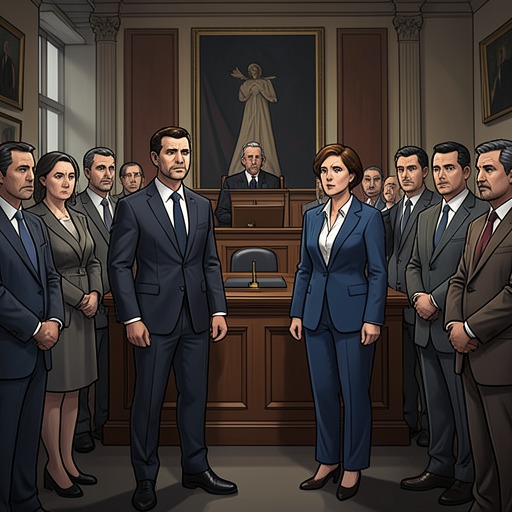
Toby Young
SCOTTISH ROMANCE: My Sinful Surrender to a Highlander Werewolf (Scottish Werewolf Pregnancy Romance) (Historical Medieval Shape Shifter Paranormal Science Fiction Short Stories)Toby Young is introduced as an imposing businessman accustomed to controlling negotiations through money, confidence, and pressure. In his meeting with Vivian McKenzie, he arrives early in a charcoal suit and red power tie, presenting himself as a polished professional while trying to seize control of the encounter. His manner is calculated to intimidate, but Vivian recognizes the performance and refuses to let him dictate the terms. Their confrontation becomes the central evidence of Toby’s character: he possesses social and financial power, yet his authority is less secure when faced with someone who understands both the law and the weaknesses of his company.
Identity and Position
Toby is connected to a company whose financial position has stagnated for three years and whose new product is necessary if it is to become a growing concern again. That vulnerability explains why the contract under discussion matters so much to him. He is not negotiating from unquestioned strength, even though he behaves as though he is. Vivian has researched the company and knows that its lawyers have used obscure legal language to confuse her clients. Toby therefore encounters an opponent who can expose the gap between the appearance of corporate control and the reality of commercial decline.
His preferred method is transactional. When Vivian challenges the contract, Toby places a blank check on her desk and offers it as a way to soothe her conscience. The gesture reduces an ethical dispute to a price, implying that objections can be purchased rather than answered. He then tries to exploit Vivian’s position as an African American woman by suggesting that professional success is especially difficult for her and that his offer could make her life easier. His attempt at persuasion is not merely aggressive; it reveals a habit of interpreting people through advantage, vulnerability, and calculated reward.
Conflict with Vivian McKenzie
Vivian rejects the bribe and refuses to betray her client’s confidence. She also refuses to accept Toby’s assumption that gender and race make her easier to control. Although she despises what he represents, she insists that they can still work together if he becomes reasonable. Her demand is practical as well as moral: the contract must be rewritten in plain language, without decorative phrasing or legal jargon designed to hide what the clients are accepting.
Toby initially responds with affronted pride, making clear that no one has spoken to him in that manner before. Yet the exchange produces a value shift. He enters the meeting trying to preserve authority through intimidation and money; he leaves having softened enough to concede further negotiations. Rather than continue in a formal office, he proposes meeting Vivian for dinner to review the contract in a more pleasant setting. The invitation is professionally useful but also charged with attraction, and Vivian is unsettled by how quickly their hostility has become personal. Their first movement toward intimacy thus grows directly out of a dispute over ethics and corporate responsibility.
Desire, Conscience, and Intimacy
At his penthouse, Toby’s physical confidence replaces his earlier negotiating posture. He greets Vivian with champagne, openly expresses his desire, and becomes amorous after she provokes him by withholding complete surrender. Their encounter is presented as a continuation of the same contest over control: Vivian tests him, while Toby attempts to turn frustration into seduction. The scene does not erase the imbalance between them, but it complicates it, because Vivian is not simply submitting to his wealth or authority; she is actively deciding how far the encounter will go.
After they have sex, the contract remains physically present in the room. They lie naked with the document spread across the bed, and the personal and commercial dimensions of their relationship occupy the same space. The image makes their connection inseparable from the ethical argument that brought them together. Vivian worries that Toby may be changing only for her, while Toby admits that she has unsettled the moral indifference that previously allowed him to exploit others. He says that he had been content to treat everyone unfairly, but that she awakened his conscience. His confession identifies the encounter as more than erotic attraction: Vivian has forced him to see himself as an active moral agent rather than a man entitled to whatever his position can secure.
Relationships and Fear of Commitment
Toby tells Vivian that he wants to continue seeing her but does not raise marriage, because a previous marriage has made him uncertain about repeating the experience. His reluctance mirrors Vivian’s own fear of commitment. Her parents died two months after their divorce, and she has also carried the regret of never marrying Angela’s father, who did not know that Angela existed until after the child’s death. Their mutual hesitation gives the relationship a particular shape: neither character treats marriage as an uncomplicated promise, and both understand intimacy through loss as well as desire.
The contrast between Toby’s earlier conduct and his later confession is crucial. The man who tried to purchase Vivian’s silence begins to speak of conscience; the businessman who wanted a contract that protected his interests becomes willing to revise the agreement; and the sexually assertive negotiator admits that he does not know whether to thank Vivian or curse her for making him reconsider his behavior. The relationship therefore develops through resistance rather than instant trust. Vivian does not redeem him by overlooking his conduct. She changes the terms on which he can remain close to her.
The Marriage-and-Market Pattern
Toby’s storyline belongs to the book’s recurring pattern of turning marriage and reproduction into economic arrangements. Abigail describes a plan to marry a rich American so that he can inherit his family fortune, then divorce him and use the money to start a business. Avril becomes an e-mail-order bride because her work visa has expired and she faces removal to Nigeria. William and his lawyer likewise discuss finding a spouse as a business deal, with transportation and citizenship exchanged for a minimum ten-year marriage and a child while the estate is protected from any claim.
Dennis offers Kember one hundred thousand dollars for surrogacy, covers her medical expenses, and links the proposal to a possible personal-assistant job paying fifty thousand dollars a year with medical benefits. Against this wider background, Toby’s conduct is not an isolated personal flaw. He represents a social world in which marriage, immigration, inheritance, labor, sex, and parenthood can all be organized through contracts. His significance lies in the possibility that such a world may still produce an ethical interruption. Vivian’s refusal shows that a contract cannot settle every question of dignity, while Toby’s altered behavior suggests—without proving—that conscience can survive inside a system built on calculation.
Change and Narrative Role
Toby does not become innocent. The evidence does not show that his earlier exploitation disappears, nor does it offer a fully secured future with Vivian. What changes is his relationship to consequence. At first, he believes that the correct payment or sufficiently forceful argument can solve the problem. By the end of the encounter, he recognizes that Vivian has made him morally visible to himself. He accepts fairer contract terms, expresses uncertainty rather than entitlement, and joins Vivian in a relationship whose future is deliberately left open.
The companies ultimately merge, and both benefit from the agreement. That practical outcome matters because Toby’s moral change is not separated from the business world; the contract becomes more just without destroying the commercial result. His arc consequently moves from domination toward negotiation, though not from power toward powerlessness. Toby Young remains a man shaped by wealth, appetite, and control, but Vivian’s opposition creates the first credible space in which he can choose fairness over advantage and connection over possession.